

December 2025 Public Humanities
A monthly newsletter connecting publicly-engaged humanities scholars and practitioners across the US (and beyond), hosted by the Department of Public & Applied Humanities at The University of Arizona.
In this issue:
Calls for proposals
Upcoming events
Publications & project news
December spotlight: Q&A with Dr. Matthew Pavesich
Employment & fellowships opportunities
If you haven’t already, please consider subscribing to Substack, a free app, to receive the newsletter in your email inbox and not miss any future news! We also encourage you to submit items to share. If you have any questions or would like to connect about the newsletter, please email Giulia Negretto at giulianegretto@arizona.edu.
Calls for Proposals
2026 Utah Conference on Community Engagement
Utah State University
The Transforming Communities Institute at Utah State University invites proposals for their 2026 Utah Conference on Community Engagement, to be held May 11–13, 2026 at USU Eastern in Price, Utah. They seek contributions from scholars, practitioners, students, and community leaders engaged in research, teaching, program implementation, or service work with real-world impact, in a variety of formats and across tracks such as community-engaged research and evaluation, teaching and administration, programming, and service.
Deadline: January 30, 2026
Learn more
2027 Conference on American History
Organization of American Historians (OAH)
The Organization of American Historians (OAH) is accepting proposals for the 2027 Conference on American History, to be held April 1–4, 2027 in San Francisco. They invite submissions for panels, roundtables, workshops, and other formats that explore any era or region of U.S. history and that foreground diverse perspectives and interdisciplinary approaches. Scholars, educators, curators, archivists, and public-history practitioners are encouraged to contribute.
Submission deadline: April 27, 2026
Learn More
Upcoming Events
SourceLab: Digital Documentary Publishing in the History Classroom
American Historical Association
December 10, 2025, 3:30 p.m. ET
Online webinar
Interested in bringing digital history into the classroom? Join this free online webinar, hosted by the American Historical Association (AHA). The session highlights the pilot program by SourceLab — a curriculum developed at the University of Illinois Urbana-Champaign — in which students learn how to edit, contextualize, and publish historical documents digitally. Attendees will see student work examples and learn how digital documentary publishing reshapes how history is taught and shared. Moderated by Kalani Craig, this event features Owen Monroe, John Randolph, and Richard Young. Registration is free and open to all.
More Information & Register
Strengthening History Communication: Reframing the Value of History and Your Institution
American Association for State and Local History (AASLH)
December 11, 2025, 1:00–4:00 p.m. ET
Virtual Workshop
This half-day session draws on the insights of the Reframing History project and is designed for history professionals at museums, historical societies, archives, and related institutions. Participants will learn research-backed strategies to communicate history’s relevance more effectively — from crafting media messages and fundraising communications to engaging the public. It’s a timely opportunity to sharpen how your institution advocates for the value of history. Registration Fee: $100 AASLH Members / $150 Nonmembers.
More Information & Register
Oral History Training
Utah Historical Society
December 6, 2025, 11:00-12:00 p.m. ET
Online Workshop
This one-hour workshop introduces participants to the fundamentals of oral-history work — covering how to prepare for, conduct, and transcribe interviews (including benefits and caveats of using AI transcription tools). Whether you’re new to oral history or looking to sharpen your skills, this session provides essential guidance for preserving community stories and personal histories. Registration is free.
More Information & Register
Publications & Project News
2025 IA National Gathering in Review
Learn what made the 2025 Imagining America (IA) National Gathering truly successful in this new report. From October 3–5 in Las Cruces, over 450 artists, scholars, students, and organizers from 150+ institutions gathered under the theme “Providing Passage: Practicing the Worlds We Want.” With 100+ speakers across 70 sessions — including community-engaged research, art, workshops, and screenings — the report captures a vibrant celebration of collaboration, culture, and collective imagination. A video of the opening plenary is included.
How to Write for Public Humanities
In this short, 4-minute video, Public Humanities authors and editors talk about the rationale behind the journal’s writing style guidelines, emphasizing the importance of knowledge accessibility and public sphere inclusivity in the journal’s mission to serve a diverse, wide, and crossover readership. The video and accompanying resources will be useful to public humanities students and scholars submitting to Public Humanities— as well as preparing work for other publications and formats!
December Spotlight: Q&A with Dr. Matthew Pavesich
Matthew Pavesich is Director of the Johns Hopkins University Writing Program. His scholarship and teaching explore writing, pedagogy, and the public humanities. See more at matthewpavesich.me and dcadapters.org. This month, we are excited to highlight his perspectives as a public humanities practitioner via a brief Q&A.
How did you become interested and involved in the Public Humanities?
By accident, essentially. Around 2013, I started the project that became DC/Adapters. At the time I saw it as a kind of public experiment, a way to document a phenomenon of visual rhetoric specific to my local community that I’d been observing: the adaptation of the D.C. flag design. I was (and am) especially interested when people use this visual move to advocate for community and civic causes. Initially, I used Tumblr to create a public archive of my findings.
It wasn’t until a few years later, I think, that I learned about the National Humanities Alliance’s Humanities for All project, which is what led me to see my project through the lens of the public humanities, to adopt that language, and to find new community.
One thing led to another, and now I’ve run DC/Adapters for over 12 years, documented over 1,000 unique images of flag adaptation, published multiple articles on the project in both scholarly and more public-facing venues, branched into multiple spin-off projects, written blog posts for the NHA, and become the public humanities officer for the Rhetoric Society of America. It’s been a fun ride!
What are some of the challenges involved in your work in the Public Humanities?
If you’re reading this newsletter, you are likely already familiar with the challenges facing public humanists. From lack of time or funding to obstacles created by the policies and practices of our institutions of higher education, there are plenty of hurdles facing the practicing or aspiring public humanist. My own projects have often illuminated my technological shortcomings, too.
Overall, though, I prefer to see obstacles as affordances – features of the terrain that can be turned into opportunities or simply worked around. And the public humanities are worth it! Public projects and partnerships are consistently some of the most exciting and fulfilling parts of my work.
Also, I take heart from the fact that significant public humanities infrastructure is emerging. This newsletter is one great example, as are the conferences and funding opportunities it identifies and amplifies. Graduate programs, both masters and PhDs, are popping up. Some universities, furthermore, are beginning to think about how public projects can be weighed for tenure and promotion. The tide seems to be turning…
What future directions do you envision for your work as a Public Humanities practitioner?
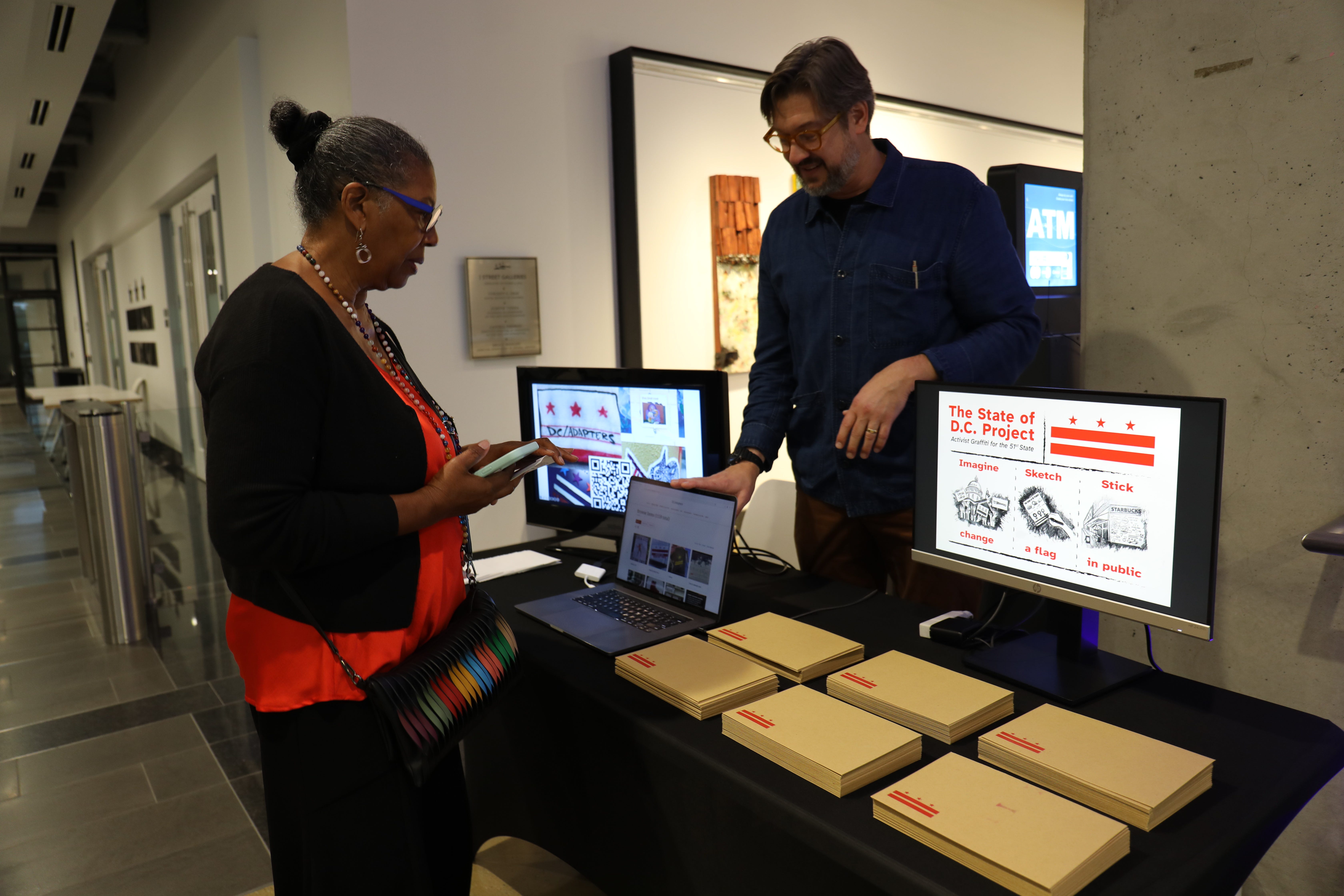
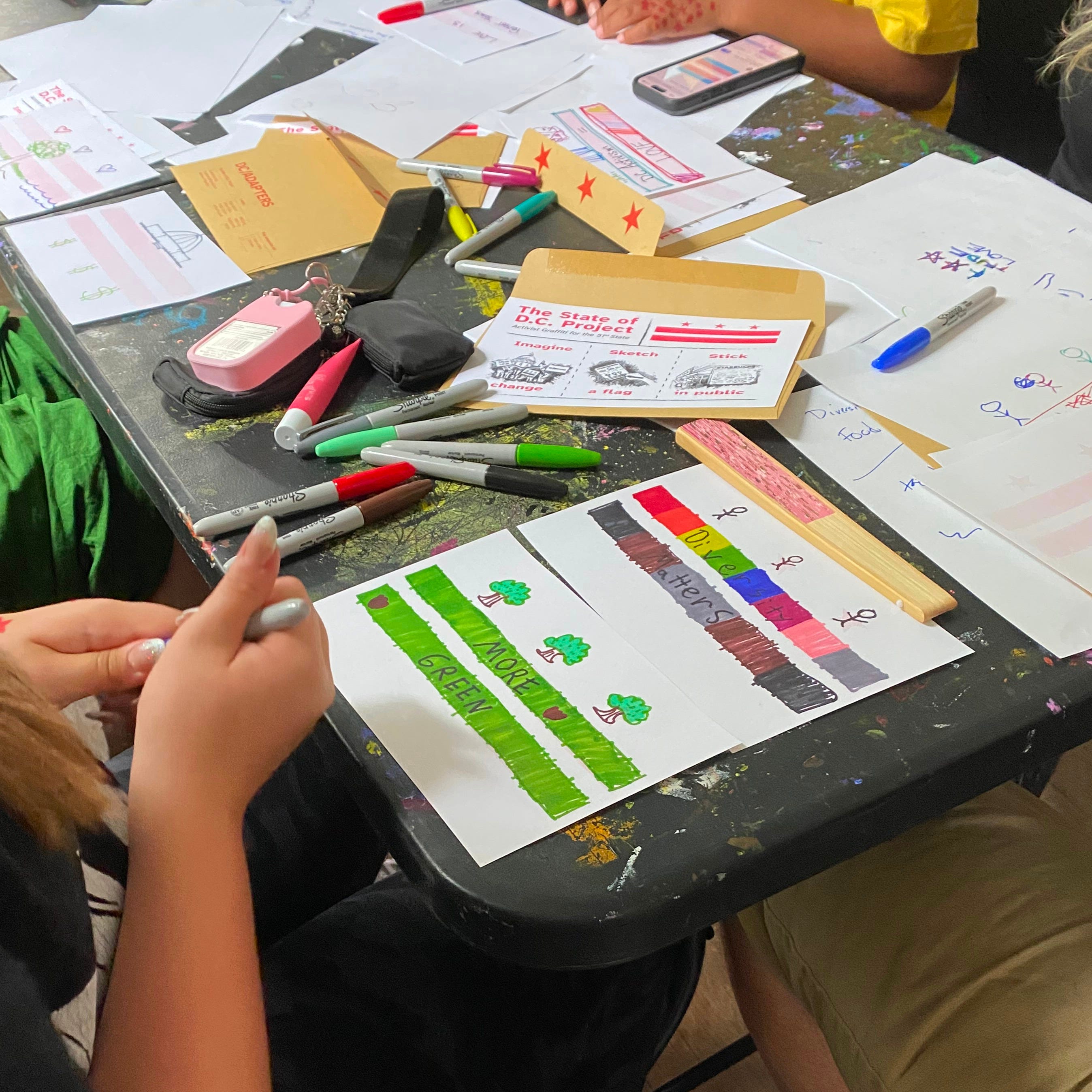
The thing that I’m most excited about right now is an ongoing evolution in my own practice. For years, DC/Adapters was a documentation project, but I’ve begun to wonder what else is possible. The first spin-off was a short film that encourages others to remix the flag, particularly in support of D.C. statehood. Next, I wanted to facilitate this invitation, to build interactive experiences in which I encourage, teach, and enable folks to adapt the flag. So, I started a workshop series in the summer of 2025. I call it the State of DC Project, and it’s a creative workshop in which I provide folks with “activist graffiti kits” so that they can add their perspectives to civic discourse in D.C.
I’m excited by this shift and am seeing where it will take me. In addition to the workshop series, I’m writing about what I call “R.A.D. moves,” or how rhetoric, art, and design open new pathways for public humanists beyond the op-ed and public lecture. I think we need to embrace more formal experimentation and, frankly, get weirder and more fun, if we hope to move the needle on substantive issues in our local communities.
There’s lots more to say here – including about how this evolution and these methods can be scaled in different ways – but I’ll end by paraphrasing something I found inspiring in Susan Smulyan’s Doing Public Humanities: instead of settling for public humanities work that translates scholarship, aim for the transformative. Words to live by, I think.
Employment & Fellowships Opportunities
Engaged Humanities Postdoctoral Fellowships
Syracuse University (Syracuse, NY)
Deadline: December 10, 2025
Postdoctoral Fellowship in African and African American Studies
Washington University (St. Louis, MO)
Applications will be reviewed beginning February 1, 2026
2026–2027 Folger Long-term Public Humanities Fellowship
Folger Institute (Washington, DC)
Assistant Professor, History & Anthropology, Public History
Southeast Missouri State University (Cape Girardeau, MO)
Adjunct Instructor in History
City Colleges of Chicago (Chicago, IL)
Mellon Assistant Professor of Climate/Environmental Humanities
Vanderbilt University (Nashville, TN)
Vice President of Development
National Humanities Center (Durham , NC)
Director of Public Programs and Engagement
Asian Art Museum (San Francisco, CA)
Visiting Assistant Professor in Digital Humanities
University of Texas Dallas (Dallas, TX)
Open until position is filled
As always, check out the latest postings on the job boards for the National Council on Public History and the American Association for State and Local History, which provide lists of opportunities that might be of interest to those trained in the public humanities.
Interested in careers in scholarly publishing? Check out the Association of University Presses and the Society of Scholarly Publishing job boards.
Interested in careers in museums? Check out the American Alliance of Museums job board.