

March 2026 Public Humanities
A monthly newsletter connecting publicly-engaged humanities scholars and practitioners across the US (and beyond), hosted by the Department of Public & Applied Humanities at The University of Arizona.
In this issue:
Calls for proposals
Upcoming events
Publications & project news
March spotlight: Q&A with Dr. Shannon Leddy
Grants & funding opportunity
Employment & fellowships opportunities
If you haven’t already, please consider subscribing to Substack, a free app, to receive the newsletter in your email inbox and not miss any future news! We also encourage you to submit items to share. If you have any questions or would like to connect about the newsletter, please email Giulia Negretto at giulianegretto@arizona.edu.
Calls for Proposals
2026 FLDH America 250 & Florida Digital Humanities: Local, National, & International Connections
Florida Digital Humanities Consortium (FLDH)
The Florida Digital Humanities Consortium invites proposals for papers, panels, roundtables, workshops, and posters exploring how digital tools and innovative practices reshape the humanities and expand public engagement. This year’s theme encourages work connected to the America 250 commemoration, including Florida’s local histories, Indigenous and diasporic narratives, environmental humanities, cultural memory, migration, and civic identity. Broader Florida‑based digital humanities projects are also welcome. The conference will be held October 30, 2026, at the University of South Florida St. Petersburg.
Deadline: April 3, 2026
2026 AI4LAM Fantastic Futures: Trust in the Loop
Artificial Intelligence for Libraries, Archives & Museums (AI4LAM)
AAI4LAM is seeking proposals for its upcoming conference exploring how institutions can navigate AI adoption while maintaining the trust fundamental to our work. Co-hosted by the Library of Congress, National Gallery of Art, and Smithsonian Institution, 2026 AI4LAM Fantastic Futures: Trust in the Loop will take place on September 15–17 in Washington, DC.
Deadline: April 6, 2026
“Precarity and Resilience”
Profession (PMLA)
The advisory committee invites submissions—whether theoretical, personal, or practice‑based—that explore the theme of precarity and resilience. Contributions may address any facet of the topic, including workforce instability; the impact of AI and emerging technologies; the defunding of the humanities; challenges to and support for DEI initiatives; retention, promotion, and tenure policies; online and in‑person teaching; and the value of our work at a moment when it can feel increasingly vulnerable or undervalued.
Deadline: April 15 (abstracts); July 15, 2026 (full submissions)
2026 Utah Conference on Community Engagement
Transforming Communities Institute (Utah State University)
Proposals for posters that highlight experience engaging community members in practice, research, and teaching are still being accepted on a rolling basis. They welcome proposals that explore case studies, lessons learned, approaches to challenges, organizational processes, and capacity-building strategies that fit one of the main conference tracks.
Deadline: April 15, 2026
Upcoming Events
“The Return of the Creator Gods: A Humanities Perspective on AI”
Community College Humanities Association (CCHA)
Thursday, March 26, 4:00 PM ET
Free webinar
Humanities professor Karen Guerin examines AI and Silicon Valley culture through historical, cultural, and mythological frameworks she has explored since 2016. Previously presented at the ATINER Institute in Athens and for the CCHA in 2025, this expanded talk now considers recent reports connecting venture‑capital‑backed Big Tech with human exploitation. By analyzing the mythological impulses driving technological power structures, Guerin argues that understanding these narratives can sharpen our awareness and strengthen our agency, even when such forces resist easy liberation.
More information & Register
Commonsense Strategies for Publishing While Teaching
MLA
Tuesday, March 24, 2026, 4:00–5:00 PM ET
This webinar offers practical guidance for faculty at access‑oriented institutions, particularly community colleges, who want to strengthen their writing and publishing practices. Participants will learn strategies for identifying new writing opportunities, integrating research with teaching and community‑engaged work, and exploring diverse publishing venues. The session also highlights how scholarship produced by community college faculty can meaningfully advance and advocate for the humanities by bringing vital perspectives into broader academic conversations. The panel discussion is moderated by Dr. Brian Stipelman.
More information & Register
Publications and Project News
Poems Written in the Same Place Decades Apart: The Chicory Revitalization Project
This article explores how the Chicory Revitalization Project uses vernacular poetry from Chicory (1966–1983) as a form of “emotional history” to engage Baltimore communities in intergenerational dialogue. By digitizing the magazine and creating workshops, public events, and a new publication, the project highlights how place‑based, community‑rooted poetry fosters civic reflection on what has changed—and what has not—across decades. It emphasizes vernacular poetry’s accessibility and its power to illuminate social justice issues through lived experience.
More about Public Humanities’ latest articles
Meeting The Moment - Tactics & Tools for Activist Artists & Cultural Organizers
Listeners of the Art is Change podcast will hear how artists across the country are transforming public spaces into powerful sites of creative resistance. The episode explores why place‑based cultural responses in cities like New York, Los Angeles, and Minneapolis are becoming frontline laboratories for cultural democracy. You’ll also hear how innovative artist‑led networks and cultural organizers are teaching resistance as a craft, revealing how creativity fuels community power and social transformation.
March Spotlight: Q&A with Dr. Shannon Leddy
Dr. Shannon Leddy is a card-carrying member of the Métis Nation of British Columbia and an associate professor of art education at the University of British Columbia, whose practice focuses on using transformative pedagogies in decolonizing and Indigenizing teacher education. Her book, Teaching Where You Are: Weaving Slow and Indigenous Pedagogies, co-written with Dr. Lorrie Miller, is now available from the University of Toronto Press. This month, we are excited to highlight her perspectives as a public humanities practitioner via a brief Q&A.
How did you become interested and involved in the Public Humanities?
My first run at post-secondary education was in visual arts, art history and anthropology, so I suppose you could say I have a predisposition towards the humanities, especially with regards to the relationship between the arts and public culture. My path towards teaching at UBC has been long and winding, and probably started when I was a paid tour guide at the Vancouver Art Gallery in the mid 90s to early 2000s. The power of art as a form of communication and of public discourse as collaborative sense making has become a driver for my subsequent work as a high school social studies and art teacher, and now as a professor of art education. My identity as a Métis educator also factors into this as there remains a significant need for public education, discourse and sense making regarding our relationship to Canada as Indigenous peoples, our contributions to the cultural life of our country, and the complex and often very painful legacies of our collective past.
What are some of the challenges involved in your work in the Public Humanities?
We work in one of the most prestigious publicly funded research institutions in Canada, many of the disciplines within which are rooted in positivism and quantitative research and reporting practices. While these approaches to academic work remain crucial to addressing many of the issues we face as a society and as individuals, it sometimes feels like our findings become separated from the very people whose needs we are trying to meet. Much of the work done in the areas of the humanities relates to the more qualitative elements of human experience; our stories, our modes of personal expression, the fabric of experience that binds us together. In my work, I focus on amplifying Indigenous voices, perspectives and stories in ways that are infusive rather than additive, to defy their historic marginalisation and silencing. This is not always met with open hearts and minds, nor with actions that back up words. I take comfort, however, in knowing that I am part of a growing movement, standing on the shoulders of those who came before me to lift up those who will come after me, and that is work that is worth doing.
What future directions do you envision for your work as a Public Humanist practitioner?
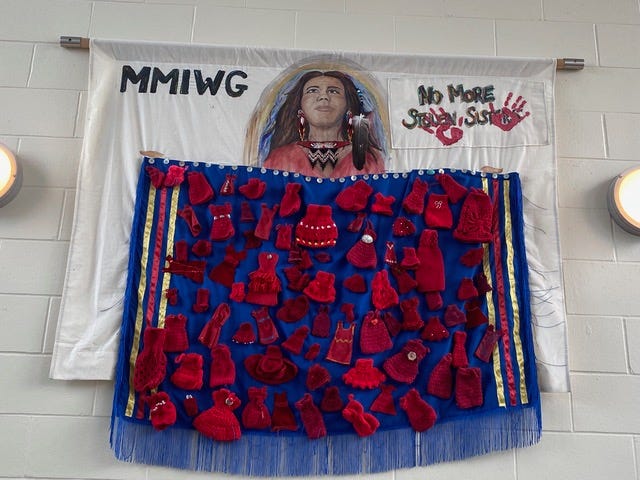
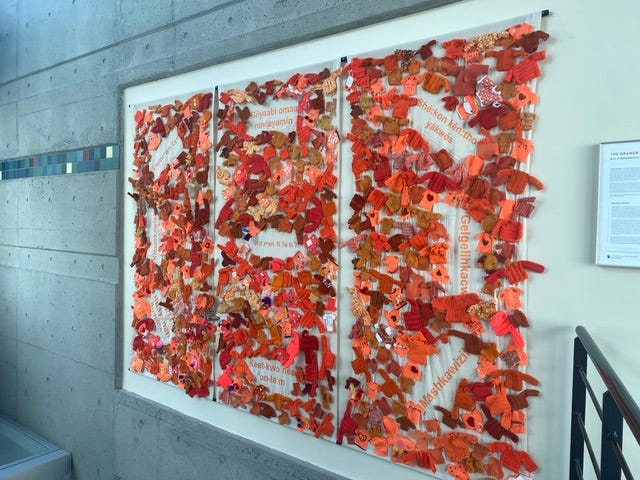
There are a couple of public art installations I was part of in the Scarfe building over the past two years: the Tiny Orange Shirt project and the Tiny Red Dress project, inspired by Jennifer Kent Symmons and Jamie Black, respectively. These projects were collaborative, community oriented, and their lasting material presence invites ongoing inquiry and dialogue in learning spaces and public places. The feedback we have received from this work, and the number of similar installations it has spurred, has been really exciting, so I am looking forward to creating more collaborative opportunities like these, and grounding some research around them as well.
The other projects I am excited about relate to collaborating with Indigenous graphic artists and community members to share stories of survival in the face of colonial forces, and to generate data with Indigenous and non-Indigenous young people in Canada and Australia in order to collaboratively formulate a policy statement on climate change education for both countries, and a book project about working with the art of Indigenous artists. So, there is a lot of work yet to be done, but I am excited about all of it!
Grant & Funding Opportunity
Keeley Schenwar Memorial Essay Prize
Truthout
This annual prize recognizes original essays by writers who are currently or formerly incarcerated, uplifting narratives that shed light on the realities of imprisonment, policing, and related issues. Two winning essays of 1,500 words or fewer receive a $3,000 award, supporting authors whose lived experience offers vital insight into systems of incarceration and their broader social impact.
Deadline: May 29, 2026
Employment & Fellowships Opportunities
Coordinator, Archival Services (American Heritage Center)
University of Wyoming (Laramie, WY)
Deadline: open until filled; complete applications received by March 12, 2026 will receive full consideration
Visiting Senior Fellowships (Center for Advanced Study in the Visual Arts)
National Gallery of Art (Washington, DC)
Deadline: March 21, 2026
Postdoctoral Fellowship on Public Policy and the Humanities (Department of African American and African Diaspora Studies)
Indiana University (Bloomington, IN)
Deadline: March 31, 2026
Mellon Assistant Professor in Culture, Advocacy, & Leadership (College of Arts and Science)
Vanderbilt University (Nashville, TN)
Deadline: March 31, 2026
Archivist, Historian for Public Engagement and Research Services (Newcomb Institute)
Tulane University (New Orleans, LA)
Deadline: April 24, 2026
IonE Postdoctoral Fellowship (Institute of the Environment)
University of Minnesota (Minneapolis/St. Paul, MN)
Deadline: April 29, 2026
Professor of Practice/Associate Professor of Practice in the School of Future Media
University of Hong Kong (Hong Kong)
Deadline: Review of applications will start as soon as possible and continue until September 30, 2026, or until the position is filled
As always, check out the latest postings on the job boards for the National Council on Public History and the American Association for State and Local History, which provide lists of opportunities that might be of interest to those trained in the public humanities.
Interested in careers in scholarly publishing? Check out the Association of University Presses and the Society of Scholarly Publishing job boards.
Interested in careers in museums? Check out the American Alliance of Museums job board.